
Guitar Player Magazine – October 2021
Guitar Player Magazine October 2021
FLAVOR ENHANCER
Martyn Booth improves upon the traditional SG recipe with his Signature electric.
TESTED BY DAVE HUNTER
ALTHOUGH HE’S BEEN designing, building and repairing top-flight guitars for professional players for some four decades, Martyn Booth is less well-known in the U.S. than he deserves to be. The British luthier’s current flagship electric model evolved from a design he created while working for Gibson. It briefly graced the lineup from one of Japan’s biggest makers, but it arguably never reached its ultimate form until Booth decided to make the thing himself.
If the outline of the Martyn Booth Signature looks familiar, chances are you’ve encountered this talented and respected British luthier’s work without even knowing his name. Booth designed an acclaimed electric guitar manufactured by Yamaha in Taiwan in the late 1980s and early ’90s known as the Image in the U.S. and the MSG in the U.K. While the upmarket versions never established the reach of their predecessors, including the SG2000, many landed in the hands of notable pros. Given the value and quality it represented, the MSG Deluxe from that lineup has been sought after ever since production ceased.
In the early 2000s, Booth launched his own range of guitars, taking the MSG concept considerably upscale as a custom-grade instrument produced in limited numbers by the man himself. Since then, artists have continued to flock to the design. The late Alan Murphy (Kate Bush, Level 42, Mike and the Mechanics), John Etheridge (Soft Machine, Nigel Kennedy, Caravan), Graham Coxon (Blur, solo), Matte Henderson, Nicky Skopelitis and others have played his creations, and some early adopters segued straight from the Yamaha to Booth’s hand-made update.
Put another way, the gist of the design certainly has legs, but it took several permutations and a varied career to make it what it is today.
“The original idea dates from 1979,” Booth explains to Guitar Player. “I was working for Norlin Music at their Gibson U.K. distribution center, doing repair and quality-control work. The team was asked what we thought of several new Gibson models, like the 335-S, the Paul and the SG. I immediately said
I thought that there was a better way to design and market a solid 335. Top U.K. management were most unimpressed with my impertinence, but I drew up the first design anyway, thinking, Well, if you won’t make it, maybe one day I will.
“As the idea developed, I realized that the advantages of lighter weight and better access were only the start. I could add coil splits to expand the versatility of sounds onstage, and I could use figured book- matched carved maple tops rather than the typical poorly matched three-piece plain maple tops that were common at the time. And then the whole plan had to be shelved as Gibson closed the U.K. distribution center and I settled into a life of self-employment and guitar repairs.”
Through much of the ’80s, however, Booth worked for Yamaha U.K. doing final setup and quality checks, and toward the end of that decade the maker wanted a follow-up to the successful SG range that could compete with the pointy-headstock, double-locking-whammy guitars of the era. Booth adapted his existing design to hold a Floyd Rose vibrato system, tweaked other specs for Yamaha’s manufacturing, and the MSG — for Martyn’s SG — was born. Yamaha USA settled on calling it the Image in the U.S. for fear of associations with the flavor enhancer monosodium glutamate.
“And just when you think everything is going well,” Booth adds, “in 1990 Yamaha USA decided they wanted to run U.S.- designed guitars, not British. Bye bye, Martyn! It was very disappointing.”
Yamaha’s loss, however, was eventually our gain. The guitars based on the foundational design Booth has produced in his one-man workshop in Sudbury, Suffolk,
“WHAT’S THE SECRET? RESONANCE, RESONANCE, RESONANCE!”
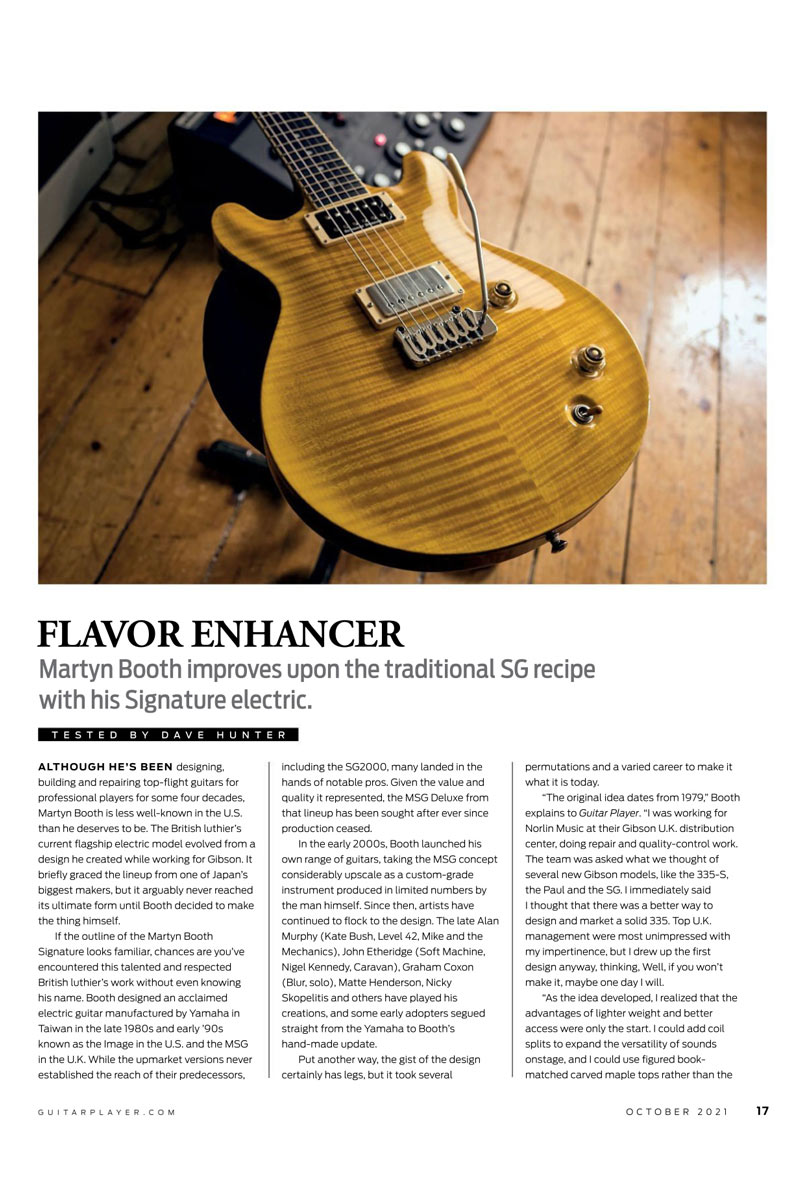
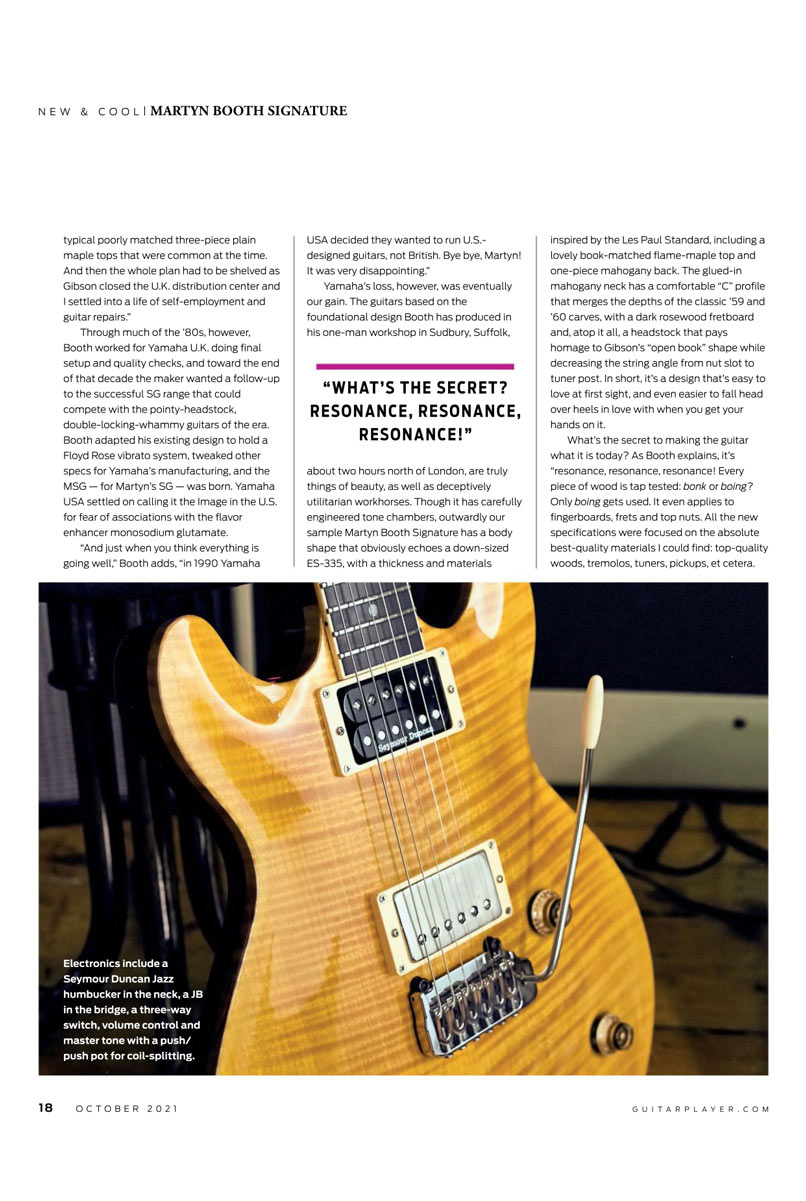
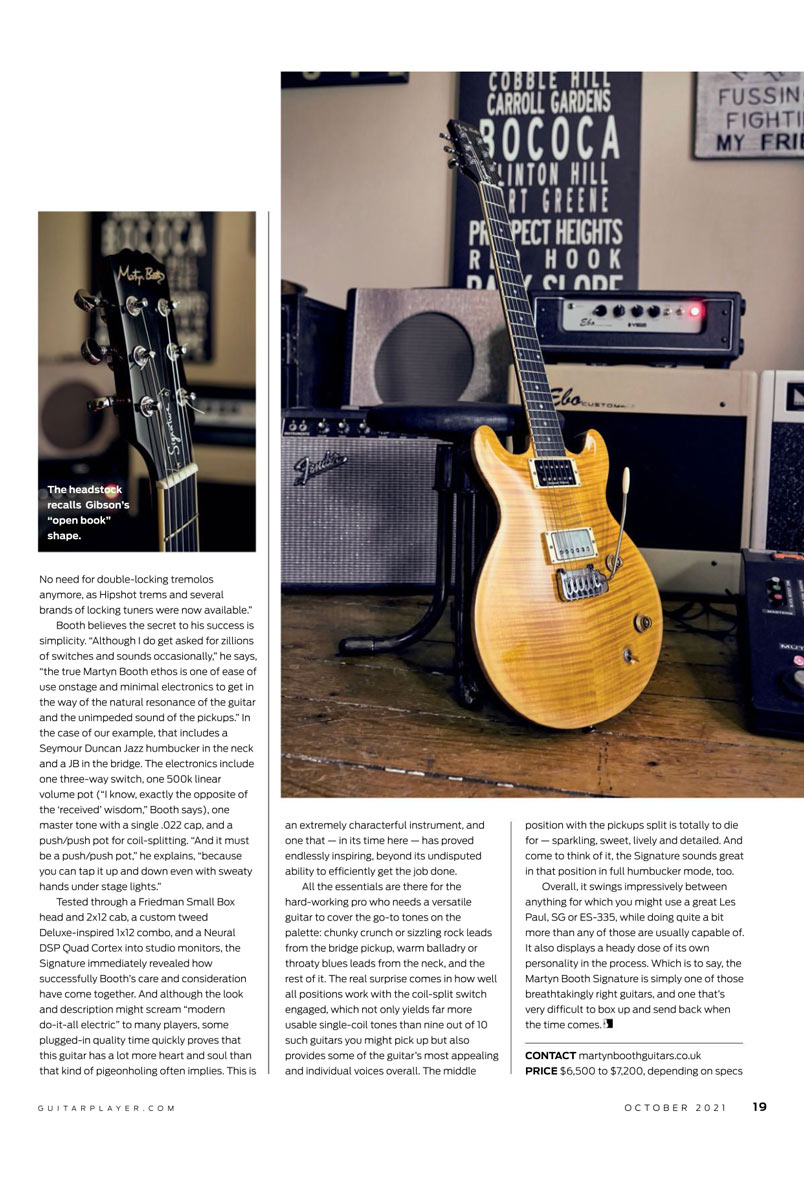
about two hours north of London, are truly things of beauty, as well as deceptively utilitarian workhorses. Though it has carefully engineered tone chambers, outwardly our sample Martyn Booth Signature has a body shape that obviously echoes a down-sized ES-335, with a thickness and materials inspired by the Les Paul Standard, including a lovely book-matched flame-maple top and one-piece mahogany back. The glued-in mahogany neck has a comfortable “C” profile that merges the depths of the classic ’59 and ’60 carves, with a dark rosewood fretboard and, atop it all, a headstock that pays homage to Gibson’s “open book” shape while decreasing the string angle from nut slot to tuner post. In short, it’s a design that’s easy to love at first sight, and even easier to fall head over heels in love with when you get your hands on it.
What’s the secret to making the guitar what it is today? As Booth explains, it’s “resonance, resonance, resonance! Every piece of wood is tap tested: bonk or boing? Only boing gets used. It even applies to fingerboards, frets and top nuts. All the new specifications were focused on the absolute best-quality materials I could find: top-quality woods, tremolos, tuners, pickups, et cetera.
No need for double-locking tremolos anymore, as Hipshot trems and several brands of locking tuners were now available.”
Booth believes the secret to his success is simplicity. “Although I do get asked for zillions of switches and sounds occasionally,” he says, “the true Martyn Booth ethos is one of ease of use onstage and minimal electronics to get in the way of the natural resonance of the guitar and the unimpeded sound of the pickups.” In the case of our example, that includes a Seymour Duncan Jazz humbucker in the neck and a JB in the bridge. The electronics include one three-way switch, one 500k linear volume pot (“I know, exactly the opposite of the ‘received’ wisdom,” Booth says), one master tone with a single .022 cap, and a push/push pot for coil-splitting. “And it must be a push/push pot,” he explains, “because you can tap it up and down even with sweaty hands under stage lights.”
Tested through a Friedman Small Box head and 2×12 cab, a custom tweed Deluxe-inspired 1×12 combo, and a Neural DSP Quad Cortex into studio monitors, the Signature immediately revealed how successfully Booth’s care and consideration have come together. And although the look and description might scream “modern do-it-all electric” to many players, some plugged-in quality time quickly proves that this guitar has a lot more heart and soul than that kind of pigeonholing often implies. This is an extremely characterful instrument, and one that — in its time here — has proved endlessly inspiring, beyond its undisputed ability to efficiently get the job done.
All the essentials are there for the hard-working pro who needs a versatile guitar to cover the go-to tones on the palette: chunky crunch or sizzling rock leads from the bridge pickup, warm balladry or throaty blues leads from the neck, and the rest of it. The real surprise comes in how well all positions work with the coil-split switch engaged, which not only yields far more usable single-coil tones than nine out of 10 such guitars you might pick up but also provides some of the guitar’s most appealing and individual voices overall. The middle position with the pickups split is totally to die for — sparkling, sweet, lively and detailed. And come to think of it, the Signature sounds great in that position in full humbucker mode, too.
Overall, it swings impressively between anything for which you might use a great Les Paul, SG or ES-335, while doing quite a bit more than any of those are usually capable of. It also displays a heady dose of its own personality in the process. Which is to say, the Martyn Booth Signature is simply one of those breathtakingly right guitars, and one that’s very difficult to box up and send back when the time comes.
CONTACT martynboothguitars.co.uk
PRICE $6,500 to $7,200, depending on specs